
RS 34 Float heights, Wet vs Dry
- daveo
-

- Offline
- Premium Member
-

Registered
- Posts: 3187
- Thanks: 906
Re: RS 34 Float heights, Wet vs Dry
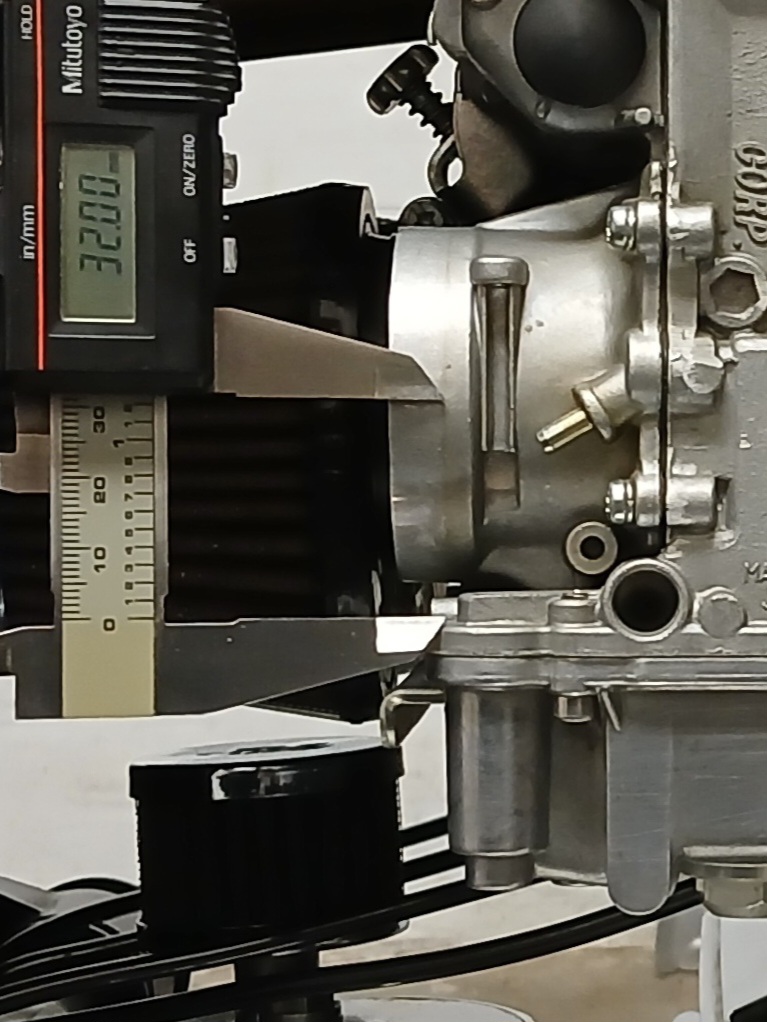
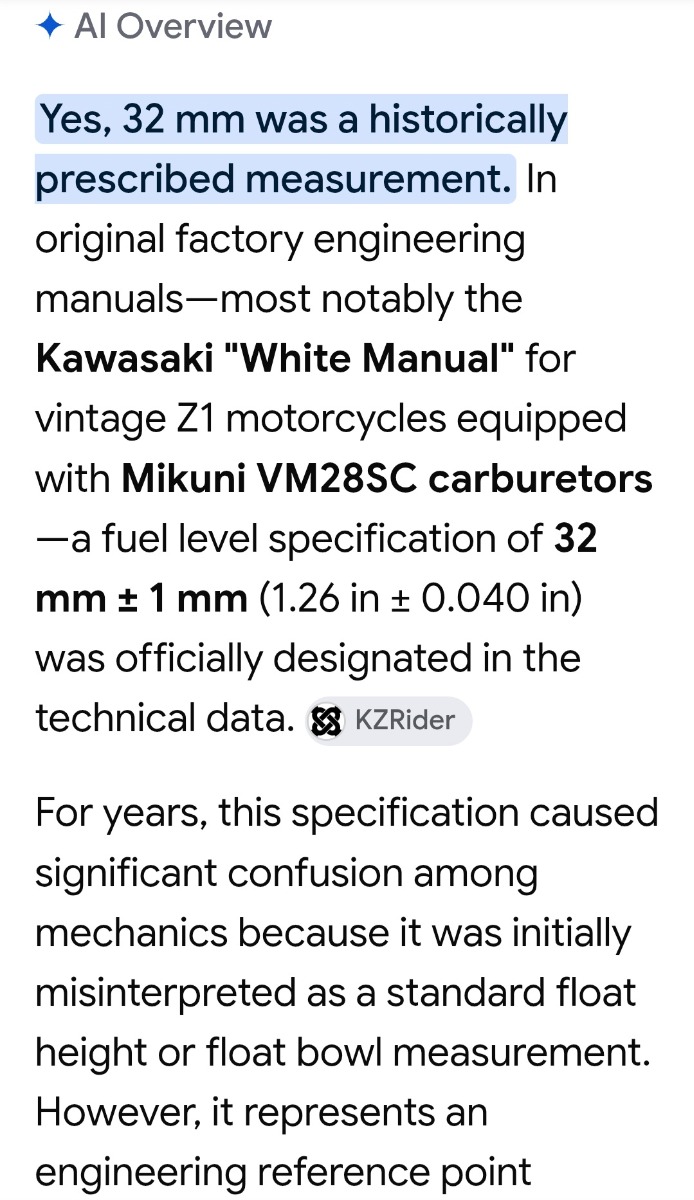
26 Oct 2026 07:42 - 26 Oct 2026 10:05That 32mm fuel level is spec'd in the Z1 White Manual specifically for VM 28SC carbs. We don't know, nor have we found, a fuel level spec for distance in mm below the carb bore centerline of RS carbs. If remembering correctly, there is a (clear tube) spec for distance relative to the bowl mating surface. Don't assume the 32mm spec in the White Manual is accurate for RS carbs.The discrepancy makes no sense until one realizes that the 32mm fuel level spec is the distance from the carb bore centerline to the fuel level in the float bowl.
Perusing the available documentation of the RS series carbs unfortunately shows no spec for fuel level below the bore centerline.
Good Ridin'
slmjim & Z1BEBE
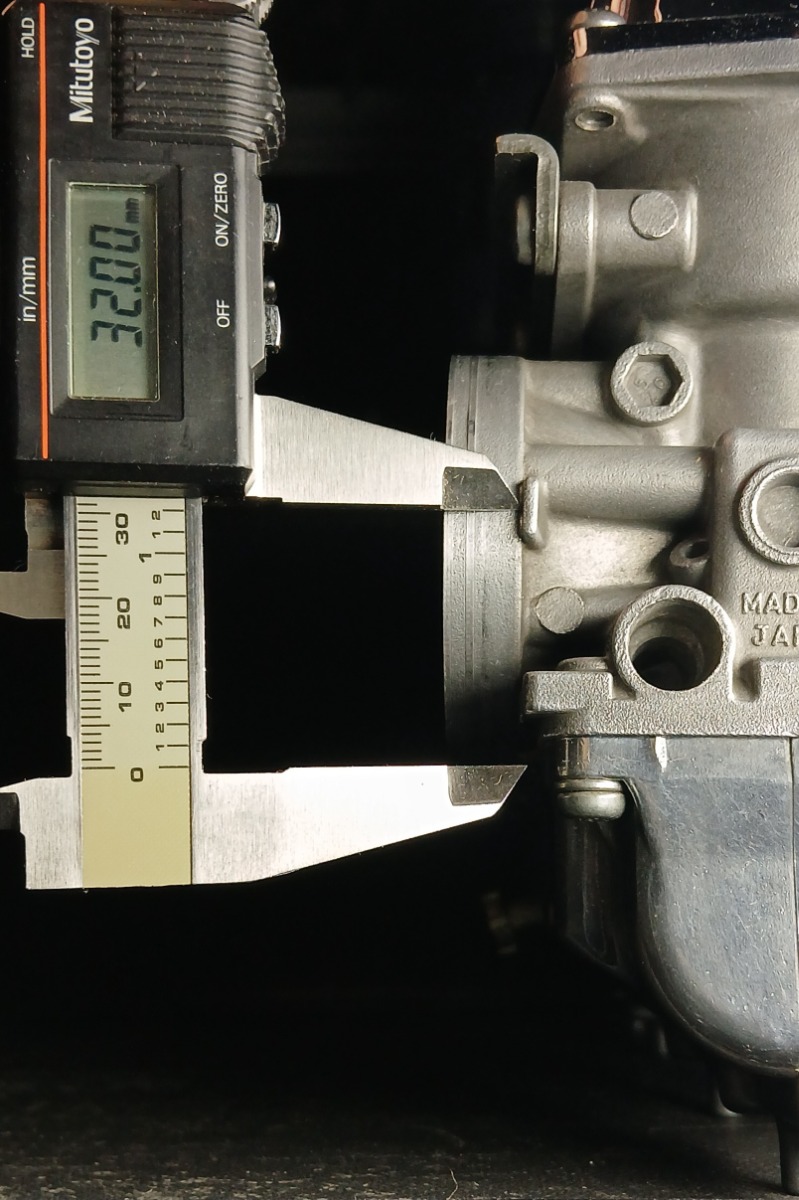
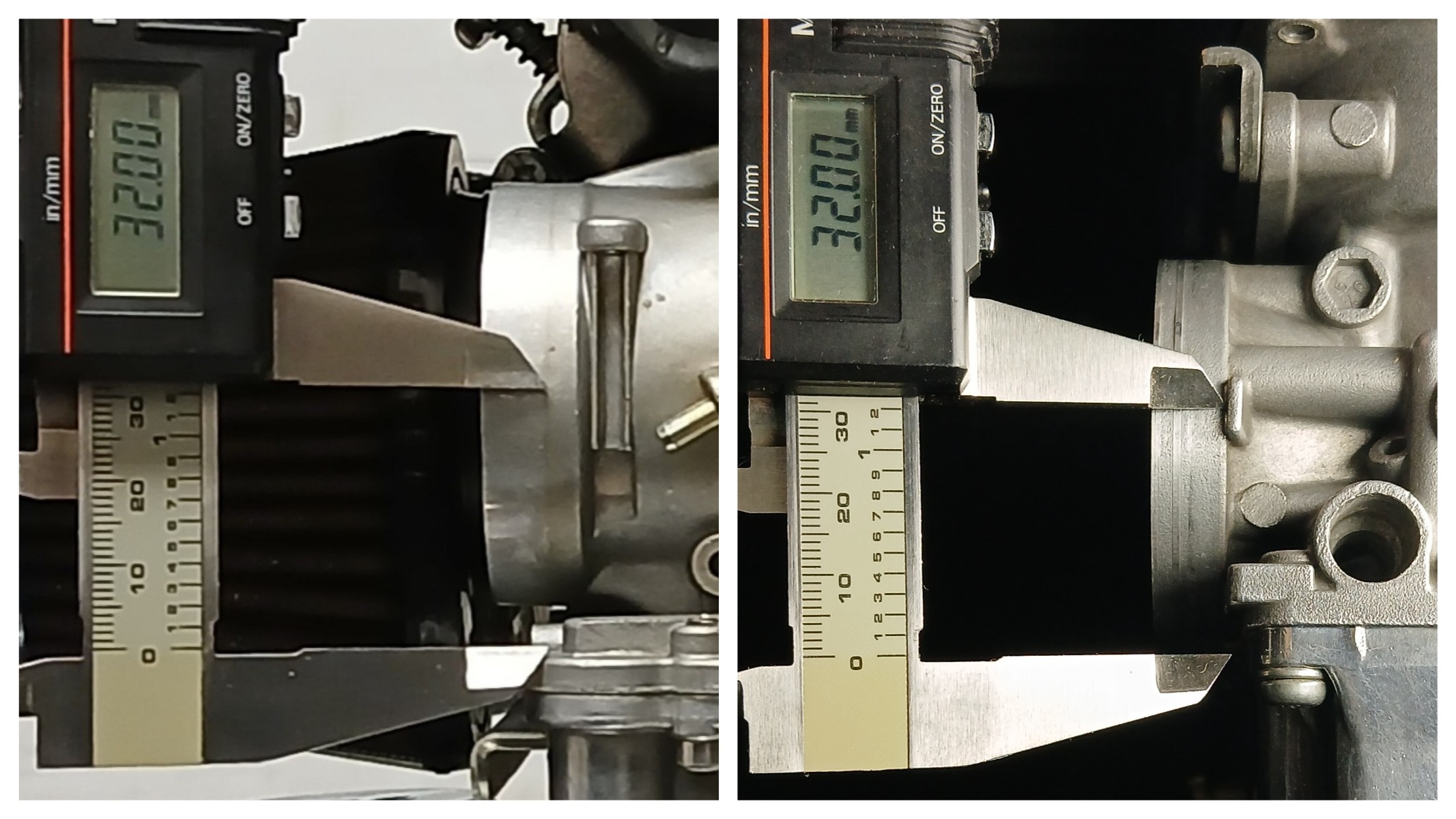
The 32mm measurement noted falls in-line with the fuel level being 4mm+/- above the bowl top when utilizing the clear-tube method, with floats set at 17mm per the Mikuni RS manual instructions:
Good Ridin'
slmjim & Z1BEBE
Coincidence?
Mikuni BS34 measures 3mm below carb body
Possibly, but...
🤔
Google query response:
Thoughts?
1982 KZ1100-A2/1170 sleeper 😀
Last edit: 26 Oct 2026 10:05 by daveo.
Please Log in or Create an account to join the conversation.
- TexasKZ
-

- Offline
- Platinum Member
-

Registered
- Posts: 8414
- Thanks: 2800
Re: RS 34 Float heights, Wet vs Dry
26 Oct 2026 10:27
It seems to me that one crucial element has been overlooked in all this; the internal design of the various carburetors. How far down does the emulsion tube extend? How far from the venturi centerline are all of the various jets?
Also, also, the tilt of the carburetors when installed will affect the clear tube method. IF the top of the fuel bowl is perfectly parallel to the venturi bore, and IF the carburetor is perfectly vertical when installed, then the clear tube placement is largely irrelevant, as the fuel level will be the same all around the carburetor. HOWEVER, most carbs seem tilted, if just a little. This will make the fuel level lower on the intake side than on the outlet (engine) side, necessitating a measurement at exactly the center. Oh, but this will also be affected by the internal design. IF there is plenty of room above the fuel level AND the bowl is perfectly symmetrical in every way, then tilting the cylinder and carburetors forward will make no difference, the vertical centerline will still be the point to measure. On the other hand, if the bottom of the carb body is very close to the fuel height when the carbs are perfectly vertical, then tilting them will make the vertical centerline no longer viable as a measurement point. The reading there will be increasingly inaccurate as the carbs are tilted farther forward.
Also some more, it seems to me that carburetor bowls should never leak, no matter where the fuel level lands.
1982 KZ1000 LTD parts donor
1981 KZ1000 LTD slowly moving toward resurrection
2000 ZRX1100 not ridden enough
www.kzrider.com/forum/11-projects/620336...amateur-build-thread
1981 KZ1000 LTD slowly moving toward resurrection
2000 ZRX1100 not ridden enough
www.kzrider.com/forum/11-projects/620336...amateur-build-thread
The following user(s) said Thank You: daveo
Please Log in or Create an account to join the conversation.
- daveo
-
- Offline
- Premium Member
-
Registered
- Posts: 3187
- Thanks: 906
Re: RS 34 Float heights, Wet vs Dry
26 Oct 2026 18:17
My current RS34's were brand new when installed last year.
I double checked the factory float settings (17mm per the manual instructions), and replaced jets to match my previous set. The carbs were synchronized using a Morgan Carb Tune Pro.
A few times I forgot to shut off the Pingel, but no fuel had leaked out during that day or by the next.
The bike normally gets parked in my garage on a 1.5" thick block of wood under the side stand. I'm sure that helps, along with using non-ethanal gasoline. But I think having all new internal carb components is the biggest contributor.
1982 KZ1100-A2/1170 sleeper 😀
Please Log in or Create an account to join the conversation.
- slmjim+Z1BEBE
-

- Offline
- User
-

Registered
- Enjoy Life! IT HAS AN EXPIRATION DATE!
- Posts: 1613
- Thanks: 1076
Re: RS 34 Float heights, Wet vs Dry
27 Oct 2026 06:08There's nothing in the AI response at odds with the VM28 SC documentation in the White Manual. When we were testing the 32mm fuel level theory on VM28 SC carbs, we had to determine the precise vertical centerline of the venturi bore, +/- 0.00mm, from which the +/- 1mm fuel level variation is calculated. It's not easy to establish the exact center in space of a hole from which to make a measurement with tools. That the mounting flange holes in VM28 SC's are in the same vertical plane as the bore center helps.daveo post=928695 userid=23775That 32mm fuel level is spec'd in the Z1 White Manual specifically for VM 28SC carbs. We don't know, nor have we found, a fuel level spec for distance in mm below the carb bore centerline of RS carbs. If remembering correctly, there is a (clear tube) spec for distance relative to the bowl mating surface. Don't assume the 32mm spec in the White Manual is accurate for RS carbs.daveo post=928657 userid=23775The discrepancy makes no sense until one realizes that the 32mm fuel level spec is the distance from the carb bore centerline to the fuel level in the float bowl.
Perusing the available documentation of the RS series carbs unfortunately shows no spec for fuel level below the bore centerline.
Good Ridin'
slmjim & Z1BEBE
The 32mm measurement noted falls in-line with the fuel level being 4mm+/- above the bowl top when utilizing the clear-tube method, with floats set at 17mm per the Mikuni RS manual instructions:
Good Ridin'
slmjim & Z1BEBE
Coincidence?
Mikuni BS34 measures 3mm below carb body
Possibly, but...
🤔
Google query response:
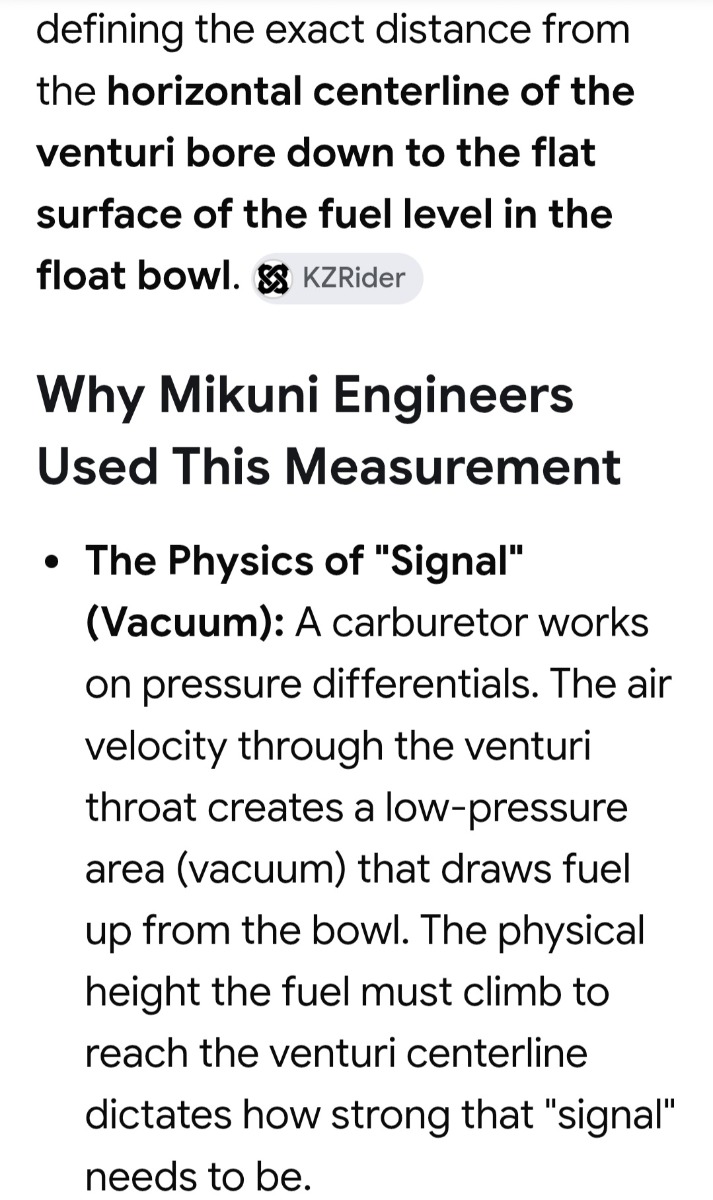
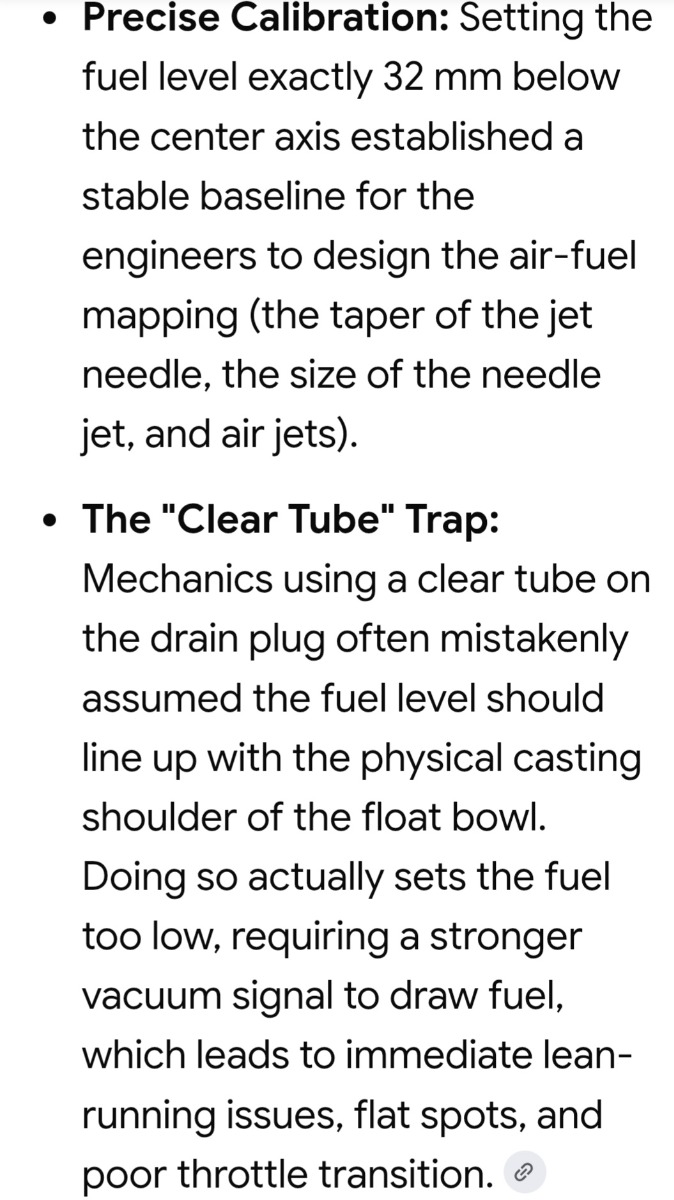
Thoughts?
Have to ask out of curiosity; how did you determine from the outside that the moveable jaw is at the exact center of the venturi bore, +/- 0.00? If it's 1mm off vertically in either direction, then the +/- 1mm fuel level variation from the engineering spec of 32mm is no longer valid.
The question of coincidence? Maybe. That's a query for Mikuni engineers.
Good Ridin'
slmjim & Z1BEBE
A biker looks at your engine and chrome.
A Rider looks at your odometer and tags.
USA
1973 ('72 builds) Z1 x2
1974 Z1-A x2
1975 Z1-B x2
1993 CB 750 Nighthawk
2009 ST1300A
www.kawasaki-z-classik.com
A Forum tightly focused on all things Z1 and Z2.
A Rider looks at your odometer and tags.
USA
1973 ('72 builds) Z1 x2
1974 Z1-A x2
1975 Z1-B x2
1993 CB 750 Nighthawk
2009 ST1300A
www.kawasaki-z-classik.com
A Forum tightly focused on all things Z1 and Z2.
Please Log in or Create an account to join the conversation.
- slmjim+Z1BEBE
-
- Offline
- User
-
Registered
- Enjoy Life! IT HAS AN EXPIRATION DATE!
- Posts: 1613
- Thanks: 1076
Re: RS 34 Float heights, Wet vs Dry
27 Oct 2026 06:42When we make fuel level adjustments off the bike, regardless if still mounted on racks or, individual carbs off-rack, and whether by by clear tube or increment-calibrated glass cup vessels, we ensure they're plumb level. You're correct that clear tube testing should be done in line front-to-back with, and parallel to, the vertical centerline of the main jet / emulsion tube / needle jet / slide bore, since many carbs don't rest plumb level front-to-back when mounted on the engine even when the bike io on the centerstand. Obviously, attempting to evaluate fuel level with the bike on the sidestand would be futile.TexasKZ post=928700 userid=14419It seems to me that one crucial element has been overlooked in all this; the internal design of the various carburetors. How far down does the emulsion tube extend? How far from the venturi centerline are all of the various jets?
Also, also, the tilt of the carburetors when installed will affect the clear tube method. IF the top of the fuel bowl is perfectly parallel to the venturi bore, and IF the carburetor is perfectly vertical when installed, then the clear tube placement is largely irrelevant, as the fuel level will be the same all around the carburetor. HOWEVER, most carbs seem tilted, if just a little. This will make the fuel level lower on the intake side than on the outlet (engine) side, necessitating a measurement at exactly the center. Oh, but this will also be affected by the internal design. IF there is plenty of room above the fuel level AND the bowl is perfectly symmetrical in every way, then tilting the cylinder and carburetors forward will make no difference, the vertical centerline will still be the point to measure. On the other hand, if the bottom of the carb body is very close to the fuel height when the carbs are perfectly vertical, then tilting them will make the vertical centerline no longer viable as a measurement point. The reading there will be increasingly inaccurate as the carbs are tilted farther forward.
Also some more, it seems to me that carburetor bowls should never leak, no matter where the fuel level lands.
Good Ridin'
slmjim & Z1BEBE
A biker looks at your engine and chrome.
A Rider looks at your odometer and tags.
USA
1973 ('72 builds) Z1 x2
1974 Z1-A x2
1975 Z1-B x2
1993 CB 750 Nighthawk
2009 ST1300A
www.kawasaki-z-classik.com
A Forum tightly focused on all things Z1 and Z2.
A Rider looks at your odometer and tags.
USA
1973 ('72 builds) Z1 x2
1974 Z1-A x2
1975 Z1-B x2
1993 CB 750 Nighthawk
2009 ST1300A
www.kawasaki-z-classik.com
A Forum tightly focused on all things Z1 and Z2.
The following user(s) said Thank You: daveo, Wookie58
Please Log in or Create an account to join the conversation.
- canman
-
 Topic Author
- Offline
- User
-
Registered
- Posts: 15
- Thanks: 1
Re: RS 34 Float heights, Wet vs Dry
27 Oct 2026 07:44
So after reading thru all the info and assumptions, what is the consensus, do we set floats at 17 MM and forget the wet method or use the wet method to set actual fuel height ??
The following user(s) said Thank You: daveo
Please Log in or Create an account to join the conversation.
- MFP-Joe
-

- Offline
- User
-
Registered
- forever 18 when on my bike ...!
- Posts: 660
- Thanks: 873
Re: RS 34 Float heights, Wet vs Dry
27 Oct 2026 09:33With my VM28 and VM26 carburetors, I have always followed this procedure:
First, I check the float level "dry": I turn the carburetors upside down, remove the float bowls, and let the floats drop into the "closed" position by gravity. I then measure the highest point of the float relative to the sealing surface. A measurement of approximately 26 mm has always worked well for me. Once this value is correct, I reassemble the carburetors and then perform a "wet" check using gasoline—for this, I connect a transparent hose to the drain screw via an adapter. Typically, the fuel level will then be correct, sitting about 2–3 mm below the sealing surface. So far, my motorcycles and their carburetors have run perfectly using this method—the mixture has never been too lean, and I have never experienced any fuel overflowing from the carburetors.
Z1000 A1 1976
Z1000 A2 1977
Greetings, Joe
Z1000 A2 1977
Greetings, Joe
The following user(s) said Thank You: slmjim+Z1BEBE, daveo
Please Log in or Create an account to join the conversation.
- daveo
-
- Offline
- Premium Member
-
Registered
- Posts: 3187
- Thanks: 906
Re: RS 34 Float heights, Wet vs Dry
27 Oct 2026 11:15 - 27 Oct 2026 11:19Have to ask out of curiosity; how did you determine from the outside that the moveable jaw is at the exact center of the venturi bore, +/- 0.00? If it's 1mm off vertically in either direction, then the +/- 1mm fuel level variation from the engineering spec of 32mm is no longer valid.
The question of coincidence? Maybe. That's a query for Mikuni engineers.
Good Ridin'
slmjim & Z1BEBE
Here you go...
🙂
1982 KZ1100-A2/1170 sleeper 😀
Last edit: 27 Oct 2026 11:19 by daveo.
The following user(s) said Thank You: slmjim+Z1BEBE, MFP-Joe
Please Log in or Create an account to join the conversation.
- Wookie58
-

- Offline
- Moderator
-

Registered
- Posts: 6902
- Thanks: 4337
Re: RS 34 Float heights, Wet vs Dry
27 Oct 2026 12:59
There seems to be a lot of info here for VM and BS carbs but not the RS. The common denominator seems to be 3mm below the bowl gasket surface so I guess that is a good starting point
1982 KZ1000 Ltd
www.kzrider.com/forum/11-projects/617631...-82-begins?start=192
kzrider.com/forum/faq-wiki/616810-electr...-fault-finding-guide
www.kzrider.com/forum/11-projects/617631...-82-begins?start=192
kzrider.com/forum/faq-wiki/616810-electr...-fault-finding-guide
Please Log in or Create an account to join the conversation.
- daveo
-
- Offline
- Premium Member
-
Registered
- Posts: 3187
- Thanks: 906
Re: RS 34 Float heights, Wet vs Dry
27 Oct 2026 14:05😵💫There seems to be a lot of info here for VM and BS carbs but not the RS. The common denominator seems to be 3mm below the bowl gasket surface so I guess that is a good starting point
Specific to the RS series, the fuel level will be 4mm +/- ABOVE the bowl and carb juncture when the Mikuni directions in the owners manual are followed.
If one insists on applying the 3mm below, clear-tube method prescribed for BS34 and others, then the float tang will need to be bent beyond reason.
I tried it ten years ago, and abandoned the idea.
But all are free to bend their tang however they wish.
😀
For reference:
1982 KZ1100-A2/1170 sleeper 😀
The following user(s) said Thank You: TexasKZ, Wookie58
Please Log in or Create an account to join the conversation.
- Wookie58
-
- Offline
- Moderator
-
Registered
- Posts: 6902
- Thanks: 4337
Re: RS 34 Float heights, Wet vs Dry
27 Oct 2026 15:03
Thanks for the clarification Daveo there is so much info I missed that in your earlier post, with my BS’s even with the dry setting spot on the level was too high and I needed to tweak the tangs about 1mm
1982 KZ1000 Ltd
www.kzrider.com/forum/11-projects/617631...-82-begins?start=192
kzrider.com/forum/faq-wiki/616810-electr...-fault-finding-guide
www.kzrider.com/forum/11-projects/617631...-82-begins?start=192
kzrider.com/forum/faq-wiki/616810-electr...-fault-finding-guide
The following user(s) said Thank You: daveo
Please Log in or Create an account to join the conversation.
- daveo
-
- Offline
- Premium Member
-
Registered
- Posts: 3187
- Thanks: 906
Re: RS 34 Float heights, Wet vs Dry
30 Oct 2026 09:21 - 30 Oct 2026 09:24
Mikuni RS instruction manual discrepancy :
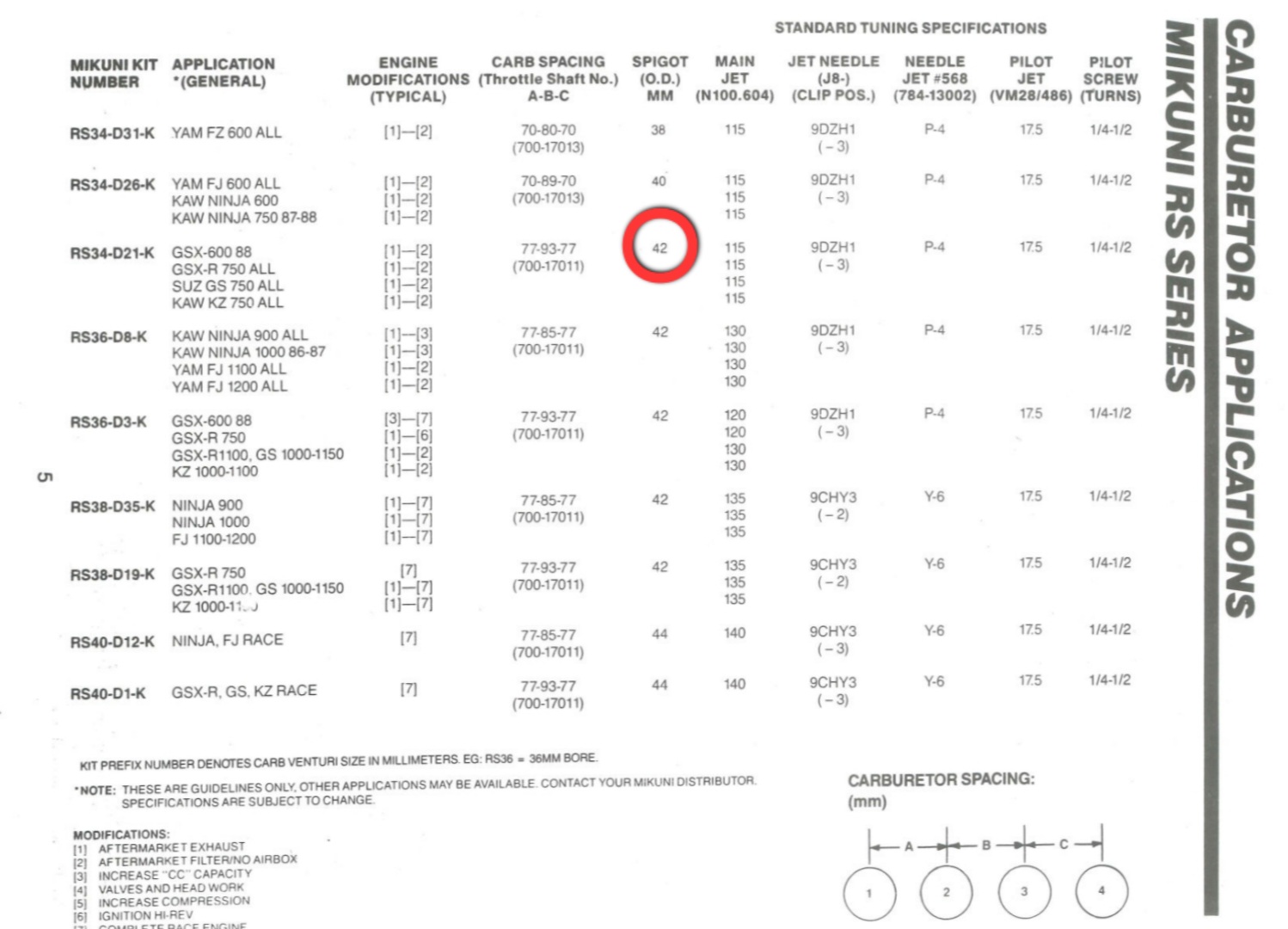
The spigot measurement is 40mm
😉
The spigot measurement is 40mm
😉
1982 KZ1100-A2/1170 sleeper 😀
Last edit: 30 Oct 2026 09:24 by daveo.
Please Log in or Create an account to join the conversation.
Moderators: Street Fighter LTD