
Improved Crankcase Venting
- Injected
-
- Offline
- User
-

Registered
- Posts: 1776
- Thanks: 1247
Re: Improved Crankcase Venting
20 Feb 2026 07:42 - 20 Feb 2026 07:43
It looks like this product has a scavenging effect rather than a venting effect. I am not sure of the long term effects this would have on the crank case internals.
I do know that increased venting capacity is always desirable on modified engines, but that has always been "non forced" venting to atmosphere. High power drag bikes sometimes use a vacuum pump to vent the crank case, I call this "forced venting". Forced venting will increase HP potential at a very small percentage which would be the amount it would take to win a race.
The stock crank case vents on all Kawasaki engines are designed and engineered for that stock capacity engine. If you increase the engine size radically that vent size is no longer within the design parameters.
I do know that increased venting capacity is always desirable on modified engines, but that has always been "non forced" venting to atmosphere. High power drag bikes sometimes use a vacuum pump to vent the crank case, I call this "forced venting". Forced venting will increase HP potential at a very small percentage which would be the amount it would take to win a race.
The stock crank case vents on all Kawasaki engines are designed and engineered for that stock capacity engine. If you increase the engine size radically that vent size is no longer within the design parameters.
1978 KZ650B2 w 1197cc Z1 engine
1977 KZ650B1 w 750cc Spectre engine
1979 KZ650C3 w 831cc Hot Rod engine
1978 KZ650C2 w 762cc DFI project
1977 KZ650C1 stock restoration project
1978 KZ650B2 modified project
1977 KZ650B1 w 750cc Spectre engine
1979 KZ650C3 w 831cc Hot Rod engine
1978 KZ650C2 w 762cc DFI project
1977 KZ650C1 stock restoration project
1978 KZ650B2 modified project
Last edit: 20 Feb 2026 07:43 by Injected. Reason: sp
The following user(s) said Thank You: Dragbike_Mike, Wookie58
Please Log in or Create an account to join the conversation.
- DoctoRot
-

- Offline
- Sustaining Member
-

Registered
- Oh, the usual... I bowl, I drive around...
- Posts: 2621
- Thanks: 784
Re: Improved Crankcase Venting
20 Feb 2026 12:20 - 20 Feb 2026 12:49
I don't understand some of logic that is being posted from that Honda website and it reads like AI slop.
It appears the T-rev is a just a plain ol' in-line PCV except it uses reed valves instead of a one way ball valve. You could use any $10 PCV and in theory get similar results. guys have been using this tech on the XS650, Nortons and a host of old british bikes that had poor crankcase venting. www.mikesxs.net/yamaha-xs650-reed-type-e...ather-valve-pcv.html
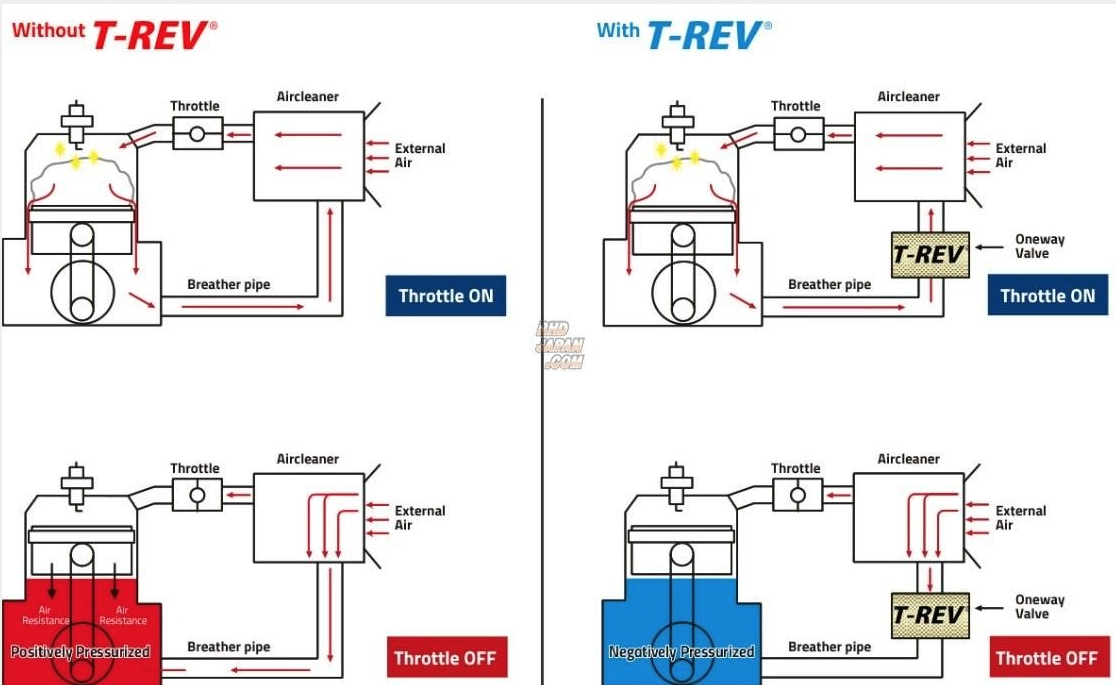
This image illustrates what the t-rev does.
It appears the T-rev is a just a plain ol' in-line PCV except it uses reed valves instead of a one way ball valve. You could use any $10 PCV and in theory get similar results. guys have been using this tech on the XS650, Nortons and a host of old british bikes that had poor crankcase venting. www.mikesxs.net/yamaha-xs650-reed-type-e...ather-valve-pcv.html
This image illustrates what the t-rev does.
Last edit: 20 Feb 2026 12:49 by DoctoRot.
The following user(s) said Thank You: Nessism
Please Log in or Create an account to join the conversation.
- DoctoRot
-
- Offline
- Sustaining Member
-
Registered
- Oh, the usual... I bowl, I drive around...
- Posts: 2621
- Thanks: 784
Re: Improved Crankcase Venting
20 Feb 2026 12:36 - 20 Feb 2026 12:36
I think PCV has more effect on the parallel twins than the inline 4s.
www.nortonownersclub.org/support/technic.../crankcase-breathing
www.nortonownersclub.org/support/technic.../crankcase-breathing
Last edit: 20 Feb 2026 12:36 by DoctoRot.
The following user(s) said Thank You: Wookie58
Please Log in or Create an account to join the conversation.
- TexasKZ
-

- Offline
- Platinum Member
-
Registered
- Posts: 8319
- Thanks: 2756
Re: Improved Crankcase Venting
20 Feb 2026 15:53The lower left panel in this illustration makes no sense to me. The fundamental assumption here is that there is pressure in the crankcase created by blowby. This pressure needs to be released to the atmosphere. For this to happen, the pressure in the crankcase must be higher than atmospheric, else a pump is needed.I don't understand some of logic that is being posted from that Honda website and it reads like AI slop.
It appears the T-rev is a just a plain ol' in-line PCV except it uses reed valves instead of a one way ball valve. You could use any $10 PCV and in theory get similar results. guys have been using this tech on the XS650, Nortons and a host of old british bikes that had poor crankcase venting. www.mikesxs.net/yamaha-xs650-reed-type-e...ather-valve-pcv.html
This image illustrates what the t-rev does.
In the lower left panel, atmospheric pressure would have to be higher than the crankcase pressure, wouldn't it?
1982 KZ1000 LTD parts donor
1981 KZ1000 LTD slowly moving toward resurrection
2000 ZRX1100 not ridden enough
www.kzrider.com/forum/11-projects/620336...amateur-build-thread
1981 KZ1000 LTD slowly moving toward resurrection
2000 ZRX1100 not ridden enough
www.kzrider.com/forum/11-projects/620336...amateur-build-thread
Please Log in or Create an account to join the conversation.
- DoctoRot
-
- Offline
- Sustaining Member
-
Registered
- Oh, the usual... I bowl, I drive around...
- Posts: 2621
- Thanks: 784
Re: Improved Crankcase Venting
20 Feb 2026 18:03
That drawing is from the Honda site with questionable info and maybe not so good for illustration this.
My understanding is this: blow by occurs more as the combustion chamber pressure rises. but blow-by also happens in pulses like exhaust waves so some element of reversion is at play. By creating a one was valve reversion cannot occur and you can only vent out.
Additionally in a throttle-off condition where vacuum in the combustion chamber is high the piston can draw gases from the crankcase past the rings and valve seals into the combustion chamber - reverse blow by. In this scenario atmospheric air can enter the crankcase. Then when the throttle is opened up again and blow by occurs the crankcase already has pressure in it compounding the problem. With a one way valve on the breather the combustion chamber vacuum creates a negative pressure in the crankcase so that when returned to throttle open condition there is not starting at a disadvantage. How much this influences performance I have no idea - all new bikes have some form of PCV but i think that is mostly an emissions thing.
Where I think this is much more important is with respect to parallel twins - i4 have opposing pistons moving up and down and they cancel each other out but in a parelell twin both pistons are moving together and because they are not balanced they are trying to move the engine's displacement back and forth through the breather hose. In the KZ750 twins this is 748cc - almost the same volume as a bottle of wine. In this condition a one way valve could create quite a strong vacuum in the crankcase and really help to remove blow by gases. The video of the Norton commando running with and without the reed valve shows how much volume changes with the installation of the valve.
I think the poorly engineered breather system on the British twins and singles where a major part of why they suffered from oil leaks because they were able to build a lot of pressure in the crank case.
My understanding is this: blow by occurs more as the combustion chamber pressure rises. but blow-by also happens in pulses like exhaust waves so some element of reversion is at play. By creating a one was valve reversion cannot occur and you can only vent out.
Additionally in a throttle-off condition where vacuum in the combustion chamber is high the piston can draw gases from the crankcase past the rings and valve seals into the combustion chamber - reverse blow by. In this scenario atmospheric air can enter the crankcase. Then when the throttle is opened up again and blow by occurs the crankcase already has pressure in it compounding the problem. With a one way valve on the breather the combustion chamber vacuum creates a negative pressure in the crankcase so that when returned to throttle open condition there is not starting at a disadvantage. How much this influences performance I have no idea - all new bikes have some form of PCV but i think that is mostly an emissions thing.
Where I think this is much more important is with respect to parallel twins - i4 have opposing pistons moving up and down and they cancel each other out but in a parelell twin both pistons are moving together and because they are not balanced they are trying to move the engine's displacement back and forth through the breather hose. In the KZ750 twins this is 748cc - almost the same volume as a bottle of wine. In this condition a one way valve could create quite a strong vacuum in the crankcase and really help to remove blow by gases. The video of the Norton commando running with and without the reed valve shows how much volume changes with the installation of the valve.
I think the poorly engineered breather system on the British twins and singles where a major part of why they suffered from oil leaks because they were able to build a lot of pressure in the crank case.
Please Log in or Create an account to join the conversation.
- diamondnik
-
 Topic Author
- Offline
- User
-
Registered
- Posts: 17
- Thanks: 3
Re: Improved Crankcase Venting
20 Feb 2026 18:27
Thanks for all the replies and suggestions... Yesterday I was working on an 1983 Honda V45 (I'm a motorcycle mechanic) and noticed a small 'catch can' packaged as a square that fits under the battery tray. It has a line in, line out and drain hose. Bough same Magna breather box on eBay, and another similar one from a different Honda to see if I can make it work. I have room under my battery tray so this will fit perfectly. I'm not a big fan of aluminum catch cans, really want to make this look OEM. Anyway, once it arrives I'll see how it fits.
I've also looked at the T-Rev and concluded it's an overpriced and over complicated PCV valve. Many valve covers have reed valves for one way venting, the T-Rev is nothing revolutionary, though they do make some big claims to back their big cost. I'm on the fence if I need a PCV valve, or if this is just an emissions thing to prevent carbon venting when the engine turns off (most likely). I've never given this topic much thought until I took off my head and was perplexed at the level of carbon build up and white exhaust valves, considering that my jetting is perfect.
I've also looked at the T-Rev and concluded it's an overpriced and over complicated PCV valve. Many valve covers have reed valves for one way venting, the T-Rev is nothing revolutionary, though they do make some big claims to back their big cost. I'm on the fence if I need a PCV valve, or if this is just an emissions thing to prevent carbon venting when the engine turns off (most likely). I've never given this topic much thought until I took off my head and was perplexed at the level of carbon build up and white exhaust valves, considering that my jetting is perfect.
Kawasaki KZ650C1
Honda CB550
Suzuki T20
Yamaha DS7, RD350, RD400
Vespa Sprint 150, P200E
Honda CB550
Suzuki T20
Yamaha DS7, RD350, RD400
Vespa Sprint 150, P200E
Please Log in or Create an account to join the conversation.
- Injected
-
- Offline
- User
-
Registered
- Posts: 1776
- Thanks: 1247
Re: Improved Crankcase Venting
20 Feb 2026 19:16 - 20 Feb 2026 19:17I would suggest you need a bigger vent tube as the crank case vent cover outlet size on all 650/750 engines was never increased.diamondnik post=921623 userid=60923Thanks for all the replies and suggestions... Yesterday I was working on an 1983 Honda V45 (I'm a motorcycle mechanic) and noticed a small 'catch can' packaged as a square that fits under the battery tray. It has a line in, line out and drain hose. Bough same Magna breather box on eBay, and another similar one from a different Honda to see if I can make it work. I have room under my battery tray so this will fit perfectly. I'm not a big fan of aluminum catch cans, really want to make this look OEM. Anyway, once it arrives I'll see how it fits.
I've also looked at the T-Rev and concluded it's an overpriced and over complicated PCV valve. Many valve covers have reed valves for one way venting, the T-Rev is nothing revolutionary, though they do make some big claims to back their big cost. I'm on the fence if I need a PCV valve, or if this is just an emissions thing to prevent carbon venting when the engine turns off (most likely). I've never given this topic much thought until I took off my head and was perplexed at the level of carbon build up and white exhaust valves, considering that my jetting is perfect.
If you have a 810cc engine you could benefit from extra venting.
I like to use the cam cover because once the tank is on its basically invisible. If you want to use the stock cover, find a way to increase the vent tube size.
1978 KZ650B2 w 1197cc Z1 engine
1977 KZ650B1 w 750cc Spectre engine
1979 KZ650C3 w 831cc Hot Rod engine
1978 KZ650C2 w 762cc DFI project
1977 KZ650C1 stock restoration project
1978 KZ650B2 modified project
1977 KZ650B1 w 750cc Spectre engine
1979 KZ650C3 w 831cc Hot Rod engine
1978 KZ650C2 w 762cc DFI project
1977 KZ650C1 stock restoration project
1978 KZ650B2 modified project
Last edit: 20 Feb 2026 19:17 by Injected. Reason: sp
The following user(s) said Thank You: diamondnik
Please Log in or Create an account to join the conversation.
- Street Fighter LTD
-
- Offline
- Moderator
-

Registered
- TURBO, Its Better to be Blown than Injected
- Posts: 5125
- Thanks: 2316
Re: Improved Crankcase Venting
21 Feb 2026 09:47
Sorry , Late to the party.
And poor pictures
I run a large hose off my cam chain cover to either a catch can in the past or vented to inside my final drive chain guard past the front half of the rear tire
This has proven to be a good place as any blow by , lubes the chain and doesn't spray oil mist onto the rear tire treads
The fitting on the cam chain cover is on the side of the cam chain tunnel which keeps oil from the cam chain slinging at the fitting / discharge point.
Old school dragbike solution used on my teams top fueler, Works just as well on the street.


And poor pictures
I run a large hose off my cam chain cover to either a catch can in the past or vented to inside my final drive chain guard past the front half of the rear tire
This has proven to be a good place as any blow by , lubes the chain and doesn't spray oil mist onto the rear tire treads
The fitting on the cam chain cover is on the side of the cam chain tunnel which keeps oil from the cam chain slinging at the fitting / discharge point.
Old school dragbike solution used on my teams top fueler, Works just as well on the street.
Original owner 78 1000 LTD
Mr Turbo Race Kit, MTC 1075 Turbo pistons by PitStop Performance , Falicon Ultra Lite Super Crank, APE everything. Les Holt @ PDM's Billet Goodies . Frame by Chuck Kurzawa @ Logghe Chassis . Deep sump 5qt oil pan. RIP Bill Hahn
The following user(s) said Thank You: Wookie58, diamondnik
Please Log in or Create an account to join the conversation.
Moderators: Street Fighter LTD